When your dryer shows a check vent warning, it is telling you it has estimated that air is not leaving the machine as fast as it should. The usual causes are lint built up in the vent, a crushed transition hose behind the dryer or a flap outside that will not open. Start with the lint filter, the hose and the outside flap. If the warning comes back after those checks, the vent run itself needs cleaning, and if it keeps coming back after a cleaning, the dryer may be the problem.
What the dryer is actually measuring
Many newer dryers watch their own airflow. LG calls its system Flow Sense, Samsung models have a vent sensor, and other brands have similar features under different names. None of them looks inside your duct. They infer restriction from what they can measure inside the machine, typically how temperatures change during the cycle and, on some models, other signals from the blower or heater.
When the readings suggest air is backing up, the dryer shows a warning on the display. Depending on the model, it may be a vent icon, a message, a row of indicator bars or a code. Some show it at the start of a cycle, some at the end. The exact behavior is in your owner’s manual, and that is the best place to confirm what your display means.
The important point is that the warning is an estimate. It is very good at noticing that something has changed. It cannot tell you where the restriction is.
What to check first
Work from the dryer outward. Each step takes a few minutes and needs no tools beyond a flashlight.
| Step | What to look for | What it tells you |
|---|---|---|
| 1. Lint filter | Lint on the screen, or a waxy film from dryer sheets that water will not pass through | Clean it every load; wash a film off with warm soapy water and let it dry |
| 2. Lint filter slot | Lint packed below the screen in the housing | Clear what you can reach with a vacuum crevice tool |
| 3. Transition hose | Hose flattened, kinked, torn or disconnected behind the dryer | Straighten or replace it with a short listed hose |
| 4. Outside flap | With the dryer running, the flap should open fully and you should feel strong warm air | A flap that barely lifts points to a restriction in the run or at the hood |
| 5. Hood or roof cap | Lint in the louvers, a stuck damper, a nest or a screen | Clear the hood from the ground if you can reach it safely |
If the flap barely moves even with a clean filter and a straight hose, the restriction is inside the wall, the attic or the termination. That part is where most of the lint ends up.
Common causes in Florida homes
Lint in a long run. Florida laundry rooms are often in an interior closet or on a second floor, with the vent running through the attic to the roof. Long runs with several elbows collect lint faster, and in a humid climate that lint sticks.
Roof caps. Roof caps are out of sight. Sparrows and other small birds nest in them, lint holds the damper partly shut, and nobody notices until the dryer complains. Our article on bird nests in dryer vents shows what that looks like.
Salt air on wall hoods. Near the coast, damper hinges stiffen and can stick halfway open or nearly closed.
Storm damage. After a hurricane or a strong storm, roof caps can be pushed out of position and wall hoods can be damaged by debris. A warning that appears right after a storm is worth investigating from outside first.
Crushed hoses in tight closets. A stackable pushed back to close a closet door flattens the hose behind it. Our guide to dryer vents for tight spaces covers ways around that.
When it is the vent and when it is the dryer
| What you see | More likely the vent | More likely the dryer |
|---|---|---|
| Outside flap barely opens | Yes | |
| Warning started gradually over weeks | Yes | |
| Lint around the hood or on the roof near the cap | Yes | |
| Warning returns right after a professional cleaning with good airflow measured | Yes | |
| Warning appears with no heat, odd noises or a burning smell from inside the cabinet | Yes | |
| Warning appeared right after the dryer was moved or installed | Check the hose first | Then the dryer |
Dryers also collect lint inside the cabinet, around the blower housing and below the lint filter slot, out of reach from the front. That buildup can trigger the same warning and needs an appliance technician. We clean the vent, not the dryer’s internals.
What not to do
Do not cover the sensor problem by running cycles on high heat to make up the time. Restricted airflow makes the dryer run hotter, and lint left in the duct is the main fuel in dryer fires. The US Fire Administration reports about 2,900 home clothes dryer fires a year in the US, and failure to clean is the leading cause, behind about a third of them.
Do not push a leaf blower into the vent from outside. It drives lint deeper into the run and can separate joints inside the wall. Our article on DIY dryer vent cleaning explains what is safe to do yourself.
How we clear it
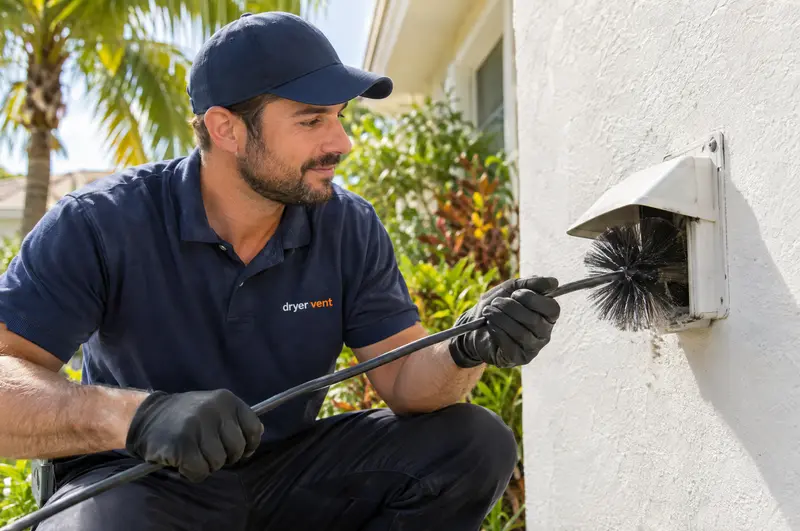
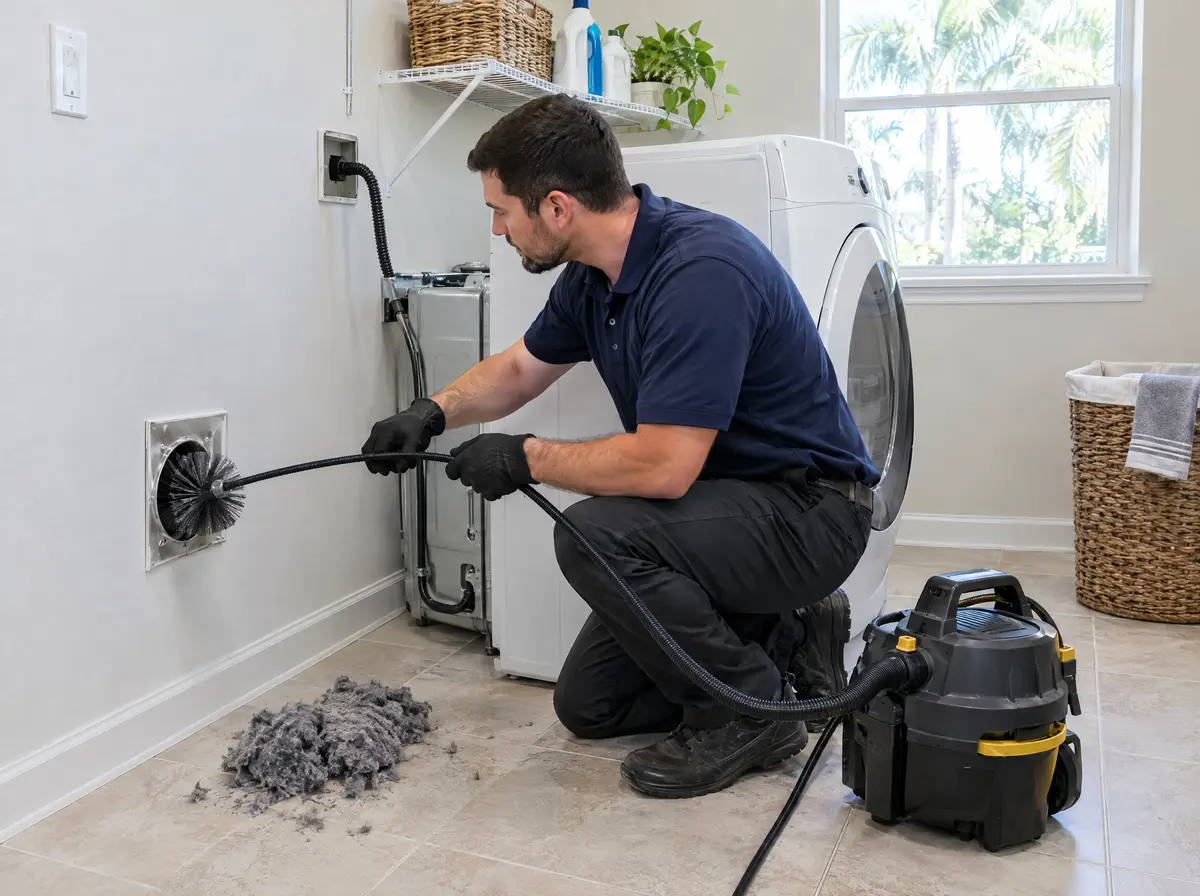
A dryer vent cleaning costs $100 to $200 for a typical home. We measure airflow at the outside termination first, pull and check the transition hose, run a rotary brush and compressed air through the full run from both ends where possible, clear the hood and free the damper, then measure airflow again. That second reading is what tells you whether the vent was the cause.
If the warning keeps coming back and you want to know whether the vent is the problem before calling an appliance technician, a dryer vent inspection measures the airflow and traces the run. For roof terminations, see our roof dryer vent cleaning service. You can reach us through the contact page.