
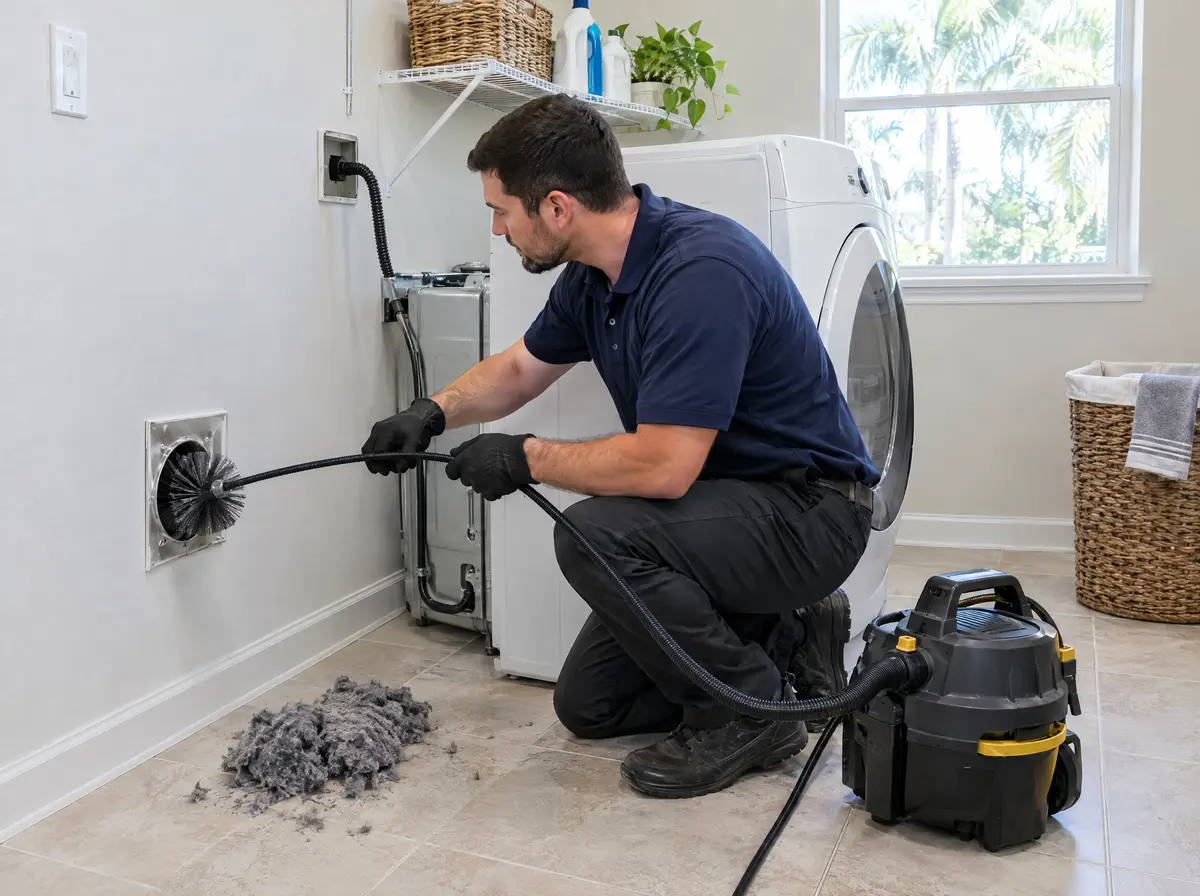
A dryer that needs two cycles to dry a normal load is almost always being held back by one of five things: a restricted vent, a lint screen blocked by film, a load that is too big, clothes that come out of the washer too wet, or a dryer that has lost some of its heat. You can rule most of them in or out in about fifteen minutes. If the lint screen is clean, the load is sensible and the outside flap barely moves while the dryer runs, the vent is the problem.
Start with the five usual causes
Each cause leaves a different trace. The table below shows the quick test for each and what the result tells you.
| Possible cause | Quick test | Result that points to it |
|---|---|---|
| Lint screen film | Run water over the clean screen | Water beads up and sits on the mesh |
| Load too large | Look at the drum mid cycle | Clothes packed in, not tumbling freely |
| Washer not spinning | Lift clothes out of the washer | Dripping wet rather than damp |
| Dryer not heating | Feel inside the drum after five minutes on high | Air feels cool or only mildly warm |
| Restricted vent | Check the outside flap with the dryer running | Flap barely opens, weak air at the exit |
Work through them in that order. The first three take a minute each and cost nothing.
Check 1: The lint screen
Pull the screen and clean it. Then hold it under a running tap. Water should pass straight through the mesh. If it pools on top, a film from dryer sheets or liquid softener is sealing the holes, even though the screen looks clean.
Scrub it with warm soapy water and a soft brush, rinse, and let it dry fully before putting it back. While the screen is out, look into the slot it sits in. Lint packs into that housing, and a long, narrow vacuum attachment can reach most of it.
Check 2: The size of the load
A dryer needs room for clothes to fall through the hot air. When the drum is packed, the middle of the load stays wet no matter how long it runs. Bedding is the usual offender, because a comforter or a set of sheets can wrap into a ball that never opens.
Try a medium load of towels on a normal heated cycle. If it dries in one cycle, your earlier loads were simply too big.
Check 3: How wet the clothes are going in
If clothes come out of the washer dripping, the dryer is being asked to remove far more water than it should. That can be a washer that is not spinning fully, an unbalanced load that stopped the spin early, or a cycle set to a low spin speed. Fixing the washer side can cut drying time with no change to the dryer at all.
Check 4: Whether the dryer is heating
Start the dryer empty on its highest heat setting. After about five minutes, open the door and put your hand inside. The air should feel clearly hot. If it feels cool, the dryer has a heating fault, such as a failed element in an electric dryer or an ignition problem in a gas one. That is an appliance repair, and no amount of vent cleaning will fix it.
Also check the cycle. Sensor dry and auto dry programs stop when the moisture sensors say the load is dry. If the sensor strips inside the drum are coated with residue, the dryer can end the cycle too early. Wiping them with a little rubbing alcohol on a cloth often solves it.
Check 5: The vent
Now look at the exit. With the dryer running on heat, go outside to the hood or look up at the roof cap if you can see it safely from the ground. A healthy vent pushes the flap open firmly and you can feel warm air from a short distance. A weak flutter, no movement at all, or lint and twigs at the opening mean the air is not getting out.
Then check the back of the dryer. Pull it out gently and look at the transition hose. It should be attached at both ends, free of kinks, and no longer than it needs to be. A foil hose crushed flat against the wall can cause all the symptoms of a clogged duct on its own.
If you have a stacked unit in a closet, or the hose disappears into a wall with a sharp bend, that bend may be the whole problem.
Putting the results together
Most people end up in one of three places:
| What you found | Likely cause | Next step |
|---|---|---|
| Strong airflow outside, dryer hot, still slow | Load size, washer spin or sensor | Adjust loads, check washer, clean sensors |
| Weak airflow outside, dryer hot inside | Restricted vent or crushed hose | Vent cleaning, possibly hose replacement |
| Little heat inside the drum | Dryer heating fault | Appliance repair |
If the vent is the cause, it is worth checking the other warning signs as well. Our list of signs of a clogged dryer vent explains each one.
Why a slow dryer is more than an annoyance
Running every load twice costs electricity or gas and wears the dryer. More important, a restricted vent makes the dryer run hotter for longer while lint sits near the heat. That is the condition behind many dryer fires, so slow drying deserves attention rather than a habit of hitting start again.
What you can fix and what to hand off
The screen, the load, the washer spin and the sensor strips are all yours to handle. Straightening or replacing a crushed transition hose is also within reach for most homeowners, as long as the new hose is a listed dryer transition duct and stays out of the wall. Our guide to DIY dryer vent cleaning covers the rest of what is safe to do yourself.
The duct beyond the wall is a different job. Lint settles along attic runs, at elbows and in roof caps where a short brush kit cannot reach. A dryer vent cleaning with Dryer Vent Florida costs $100 to $200, and we measure airflow before and after so you can see the difference in numbers, not just in drying time.