The best dryer vent for a tight space is a short, listed transition that does not need to bend sharply: a periscope vent, a short semi rigid hose with a rigid elbow at the wall, or a recessed wall box that gives the connection room inside the wall. Whatever you choose, the transition must be listed to UL 2158A, no longer than 8 feet and never concealed in a wall or ceiling. The goal is simple: get the dryer close to the wall without crushing the path the air takes out.
Why tight spaces cause so many vent problems
Florida condos and newer townhomes often put the laundry in a hall closet with bifold doors, a stackable in a kitchen alcove or a side by side pair in a narrow nook off the garage. The closet depth is barely enough for the machines. To close the doors, the dryer gets pushed back until the hose behind it folds flat.
A flattened transition hose is one of the most common faults we find. The dryer still runs, but the airflow is choked right at the start of the system. Lint builds up at the fold, drying times stretch and the dryer runs hot. Our article on foil vs rigid dryer duct explains why thin foil is so easy to crush.
What the code allows behind the dryer
The Florida Building Code, section M1502, treats the piece behind the dryer differently from the duct in the wall.
| Part | What the code asks | What it means in a tight space |
|---|---|---|
| Transition duct | Listed to UL 2158A, 8 feet maximum, not concealed | Any connector product should carry the listing and stay in view |
| Exhaust duct in the wall or ceiling | 4 inch rigid metal, smooth interior, at least 0.016 inch thick | No flexible hose hidden in the cavity |
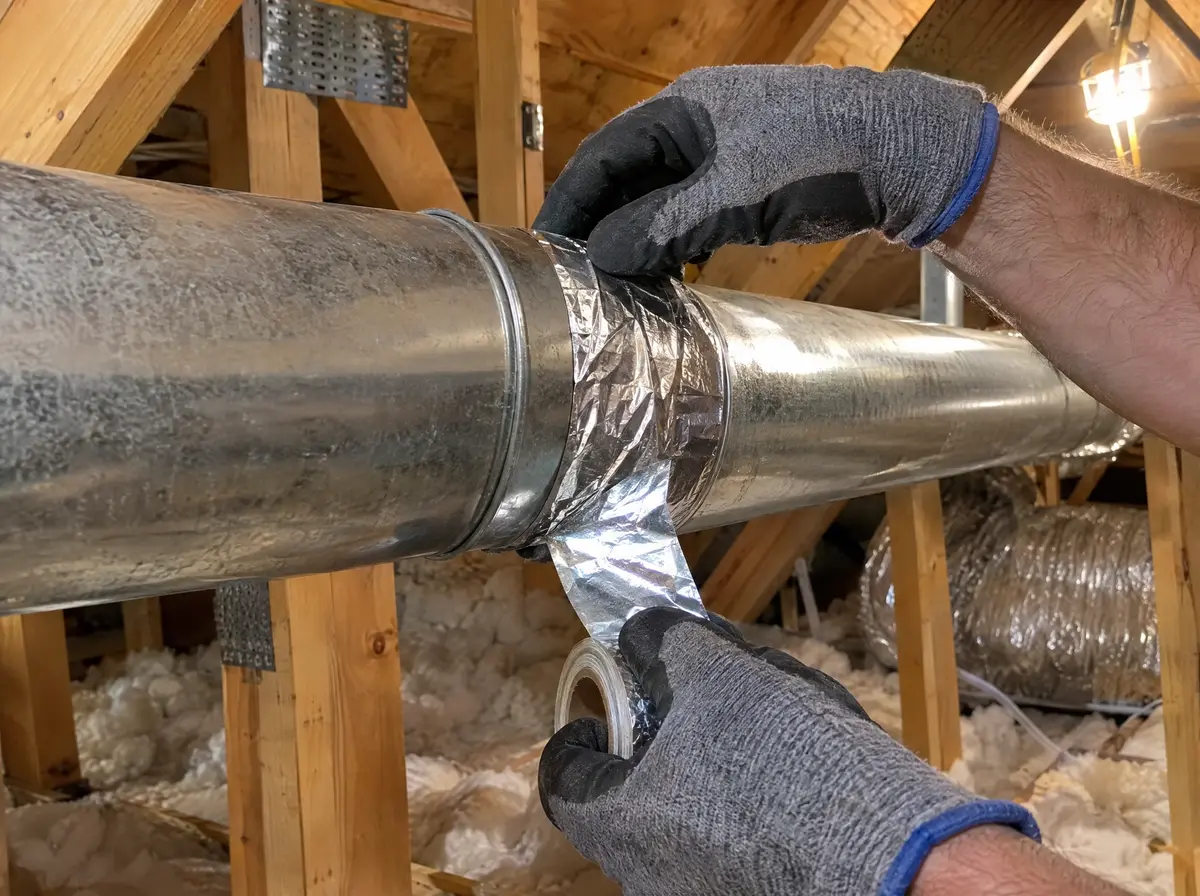
| Joints | No screws or fasteners into the duct | Seal with foil tape, not screws |
| Total length | 35 feet, less 2.5 feet per 45 degree bend and 5 feet per 90 degree bend, unless the dryer manual allows more | Tight elbows behind the dryer count against the run |
The listing applies to the product category. When you shop, look for the UL 2158A marking on the product or its packaging, and follow both the connector’s instructions and the dryer’s installation manual. Neither replaces the other.
Periscope vents
A periscope vent is a flat, rectangular metal duct that telescopes up or down. One end fits the dryer outlet, the other fits the wall opening. Because it runs flat against the back of the dryer, it lets the dryer sit much closer to the wall than a looped hose.
Periscopes work best when the dryer outlet and the wall outlet line up side to side and differ only in height. They are a good answer for many stackables and for laundry closets where the wall opening sits a little above or below the dryer outlet.
How they fail:
- The ends slip off the collars when the dryer is pushed back, especially if the clamps were never tightened.
- An offset to the side forces a twist the periscope is not built for, so installers add a short hose and the crushing problem returns.
- The flat section collects lint along its bottom and needs cleaning along with the rest of the run.
- A periscope that is too short for the gap gets stretched at its joints and opens up.
Recessed wall boxes
A recessed dryer box is a metal box set between the wall studs, with the rigid duct connected to its top or bottom. The transition hose bends inside the recess rather than behind the dryer, so the machine can go nearly flat against the wall. Dryerbox is one well known brand, and there are others.
The box keeps the transition in an open recess you can see and reach, so it is not concealed the way a hose stuffed into a cavity would be. It is the most durable answer for a tight laundry closet, but it means opening the drywall, so it fits best during a remodel or when the wall is already open for a dryer vent repair.
How they fail:
- Fitted in a wall that is too shallow for the model, so the hose still folds.
- Connected to foil hose inside the wall instead of rigid metal.
- Lint builds up in the bottom of the box when the duct exits downward and nobody cleans it.
Magnetic connectors
Magnetic dryer vent connectors hold the hose to the dryer or the wall with a magnetic ring instead of a clamp. The appeal is that the dryer can be pulled out and the connection simply comes apart and goes back together.
How they fail: The same feature is the weakness. Vibration during a cycle or a hard push back against the wall can separate the joint. When that happens, hot, moist, lint filled air blows into the space behind the dryer. In a closed Florida laundry closet, that means humidity, lint on every surface and lint near the heat source. Nobody notices until they pull the dryer out. If you use one, look behind the dryer often and replace it if it lets go more than once.
Low profile elbows
A low profile or close elbow is a rigid 90 degree fitting with a very short radius, made to sit right on the dryer outlet. It turns the air immediately and lets the dryer come closer to the wall. It is a sound choice when it is rigid metal, but each 90 degree bend reduces the allowed length of the run by 5 feet, so on a long run every elbow counts.
Choosing the right option
| Option | Space saved | Main weakness | Best for |
|---|---|---|---|
| Periscope vent | High | Slips off collars, cannot handle side offsets | Stackables, outlets aligned side to side |
| Recessed wall box | Highest | Needs the wall opened | Remodels, closets with no depth to spare |
| Magnetic connector | Moderate | Separates without warning | Only where you check it often |
| Low profile rigid elbow | Moderate | Adds resistance to the run | Short runs straight into the wall |
| Short semi rigid hose | Moderate | Can still kink if pushed too far | Closets with a few inches to spare |
Getting the dryer back without crushing anything
- Measure the gap between the dryer outlet and the wall outlet, both height and side offset, before buying a connector.
- Use the shortest listed transition that fits. Extra hose coiled behind the dryer is what gets crushed.
- Tighten both clamps and seal rigid joints with foil tape.
- Slide the dryer back slowly while someone watches the connection from the side or top.
- Stop when the hose starts to flatten. A dryer an inch further out is better than one with no airflow.
- Run the dryer and check outside that the flap opens fully.
If the wall opening is in the wrong place for any of these to work, moving it is a dryer vent installation priced at $200 to $600. We measure airflow before and after, so you can see the difference. You can book through our contact page.