
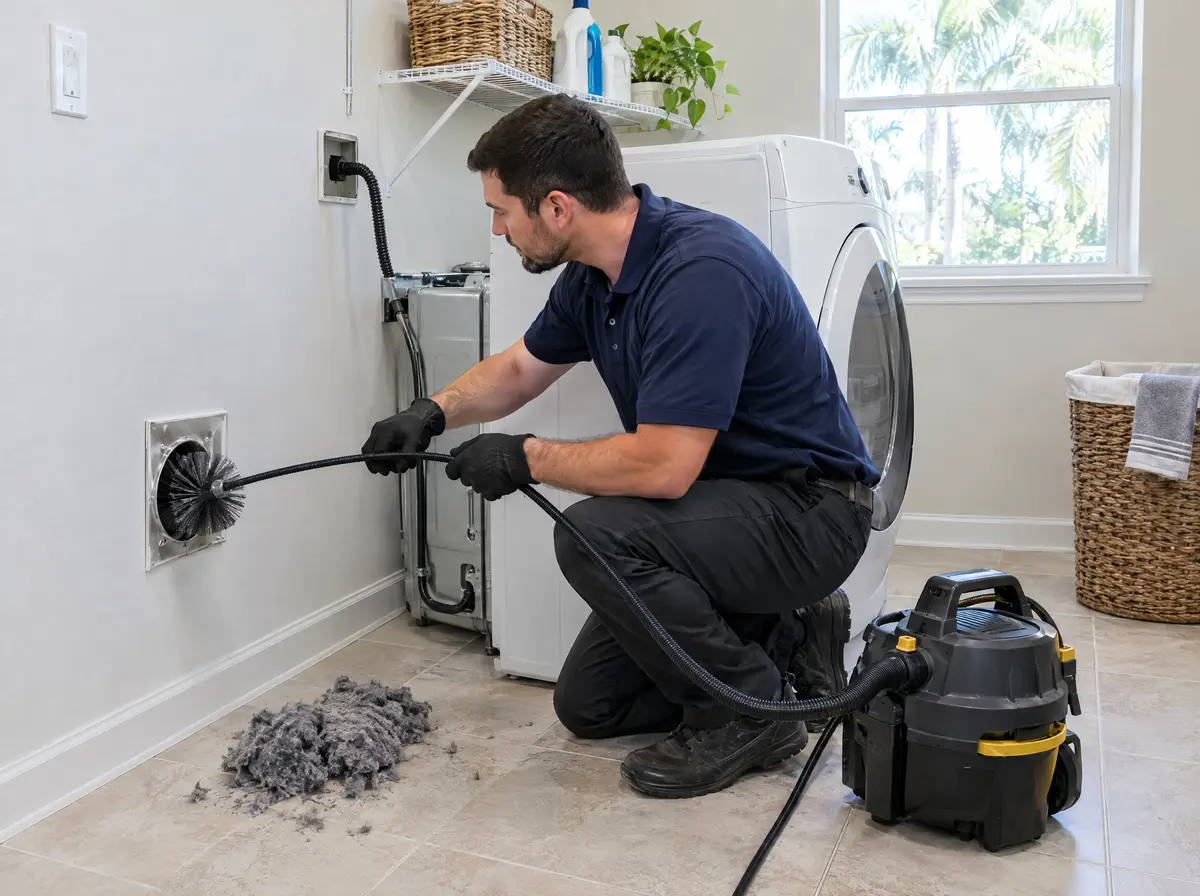
The clearest signs of a clogged dryer vent are loads that need two cycles to dry, a dryer and clothes that feel unusually hot, a laundry room that turns warm and humid, and an outside flap that barely opens when the dryer runs. Lint around the dryer door or at the outside hood is another giveaway. A burning smell is the one sign that means stop using the dryer today and have the vent checked before the next load.
Why a clog shows up the way it does
A dryer heats air, pulls it through the tumbling clothes, then pushes that warm, wet air out through the vent. When lint narrows the duct, the air slows down. Moisture stays in the drum, heat builds up inside the cabinet, and some of that air finds other ways out.
Each sign below is the same problem showing up in a different place. Taken together, they tell you how far the blockage has gone.
The eight signs
| Sign | What it usually means | What to do |
|---|---|---|
| Loads need a second cycle | Wet air cannot leave fast enough | Check the lint screen, then the vent |
| Dryer top and clothes very hot | Heat is trapped in the cabinet | Book a cleaning soon |
| Laundry room humid or warm | Air leaking at the hose or a joint | Check the hose behind the dryer |
| Outside flap barely opens | Airflow is weak at the exit | Book a cleaning |
| Lint around the door or behind the dryer | Pressure pushing lint out of seams | Book a cleaning |
| Lint, twigs or grass at the outside hood | Blocked hood or a nest | Have the cap cleared |
| Dryer stops mid cycle or shows an error | Overheating safety tripped | Stop and have it checked |
| Burning or scorched smell | Lint near heat is scorching | Stop using the dryer now |
1. Loads need two cycles
This is usually the first thing people notice. Jeans and towels come out damp after a full cycle, so you run them again. Before blaming the vent, clean the lint screen and make sure the load is not too large. If those check out, the duct is the likely cause. Our article on why a dryer takes two cycles to dry walks through how to tell a vent problem from a dryer problem.
2. The dryer and clothes feel very hot
Clothes should come out warm, not hot enough to make you pull your hand back. The top and sides of the dryer should feel only mildly warm. When the vent is restricted, the heat that should leave through the duct stays in the cabinet, and the dryer’s heating element or burner cycles on its safety limit over and over.
3. The laundry room turns humid
In a Florida home the laundry room is often already warm, so this can be easy to miss. If the room feels sticky or the window fogs while the dryer runs, moist air is escaping where it should not. The usual culprits are a transition hose that has slipped off the back of the dryer, a crushed hose, or a separated joint in the wall.
4. The outside flap barely opens
This is the most direct check you can do. Run the dryer on a heated setting, then go outside to the hood. The flap should push open firmly and you should feel strong, warm air. If the flap only flutters, or you can barely feel anything, airflow is weak somewhere along the run.
If you do not know where the vent ends, look for a hood on an exterior wall near the laundry room, or a cap on the roof above it.
5. Lint where it should not be
Lint on the floor behind the dryer, in the door gasket or around the drum seal means air pressure inside the dryer is pushing it out through gaps. A duct that cannot breathe forces the air back toward the machine.
6. Debris at the outside hood
Lint caught in the hood louvers, or grass and twigs sticking out of the opening, means the exit itself is partly closed. In Florida, sparrows and other small birds build nests in dryer hoods and roof caps all year. A damper stuck open from lint is an easy way in.
7. The dryer shuts off mid cycle
Many dryers have a high limit or thermal fuse that cuts the heat, or stops the cycle, when the cabinet gets too hot. Some show an error code. A blocked vent is a common reason the dryer reaches that point. If a thermal fuse has blown, replacing it without clearing the vent only sets up the next failure.
8. A burning smell
Lint is light, dry and burns easily. When it collects near the heat source and the air is not moving, it can scorch. If you smell anything burnt, stop the dryer, unplug it if you can reach the plug safely, and do not run it again until the vent and the dryer have been checked. The US Fire Administration’s numbers on dryer fires are in our article on dryer vent fire risk.
Signs that point somewhere other than the vent
Not every slow dryer has a clogged vent. A dryer that produces no heat at all, makes grinding or squealing noises, or will not tumble has a mechanical or electrical fault. A dryer that dries one load fine and the next poorly may simply have been overloaded. Clothes that come out of the washer dripping wet suggest the washer is not spinning properly.
Checking those first saves you a visit you do not need.
What to do once you see the signs
Start with the easy steps. Clean the lint screen, check that the hose behind the dryer is attached and not crushed, and look at the outside flap with the dryer running. If two or more of the signs above are present, or the flap is weak, the duct needs a full cleaning.
A dryer vent cleaning with Dryer Vent Florida costs $100 to $200. We measure airflow at the outside termination before we start, brush and blow out the full run from both ends where we can reach them, clear the hood or cap, free the damper, and measure again. If we find a crushed or disconnected duct instead of plain lint, we explain it and quote the repair before doing anything else.