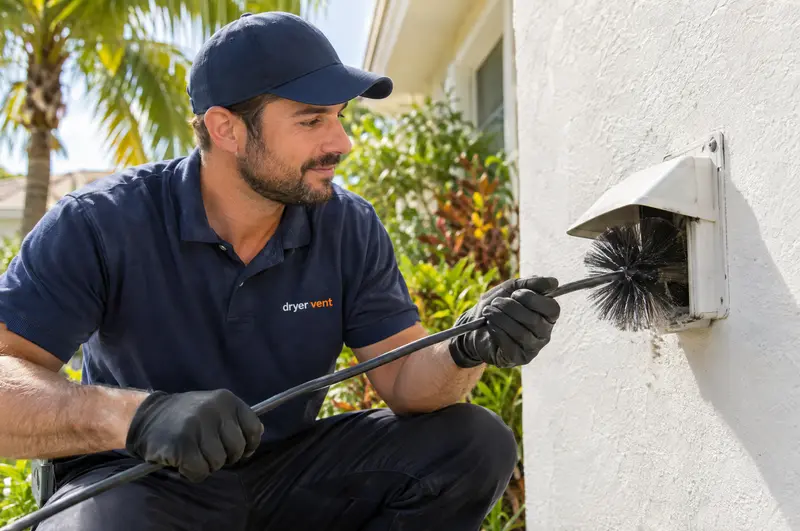
A dryer vent booster fan is a legitimate fix in one situation: the run is longer than the code allows, there is no practical shorter route, and the dryer manufacturer’s instructions allow a longer run with a booster. In every other case, the better answer is to shorten the route, reduce the bends or clear what is blocking the duct. A booster fan pushes air through a duct. It does not make a bad duct good.
Why long runs need help
The Florida Building Code, section M1502, limits the developed length of a dryer exhaust duct to 35 feet. Each 45 degree bend reduces that by 2.5 feet and each 90 degree bend by 5 feet. A longer run is allowed only where the dryer manufacturer’s installation instructions permit it.
The dryer’s own blower is sized to push air through a run of about that length. Past it, the air slows down, lint drops out, drying times stretch and the dryer runs hotter. Our article on the Florida dryer vent code shows how to work out the allowance for your run.
What a booster fan is
A dryer booster fan is an inline fan installed partway along the duct, or near the end of it, to help move air over a long distance. A proper one is built specifically for dryer exhaust. It turns on automatically when the dryer runs, usually by sensing the air pressure in the duct, and it shuts off when the dryer stops.
Ordinary bathroom or inline ventilation fans are not substitutes. They are not designed for hot, lint laden air, and lint wraps around their motors and blades.
When a booster fan is the right call
These are the situations where we recommend one:
| Situation | Why a booster may be justified |
|---|---|
| Interior laundry in a condo with a long run to the only exterior wall | No shorter route exists through the building |
| Dryer in the middle of a large single story home with no nearby wall or suitable roof path | Every route is long |
| Second floor laundry where the shortest roof route still exceeds the limit | Rerouting cannot bring it under |
| The dryer manual allows a longer run with a booster | The manufacturer has approved the approach |
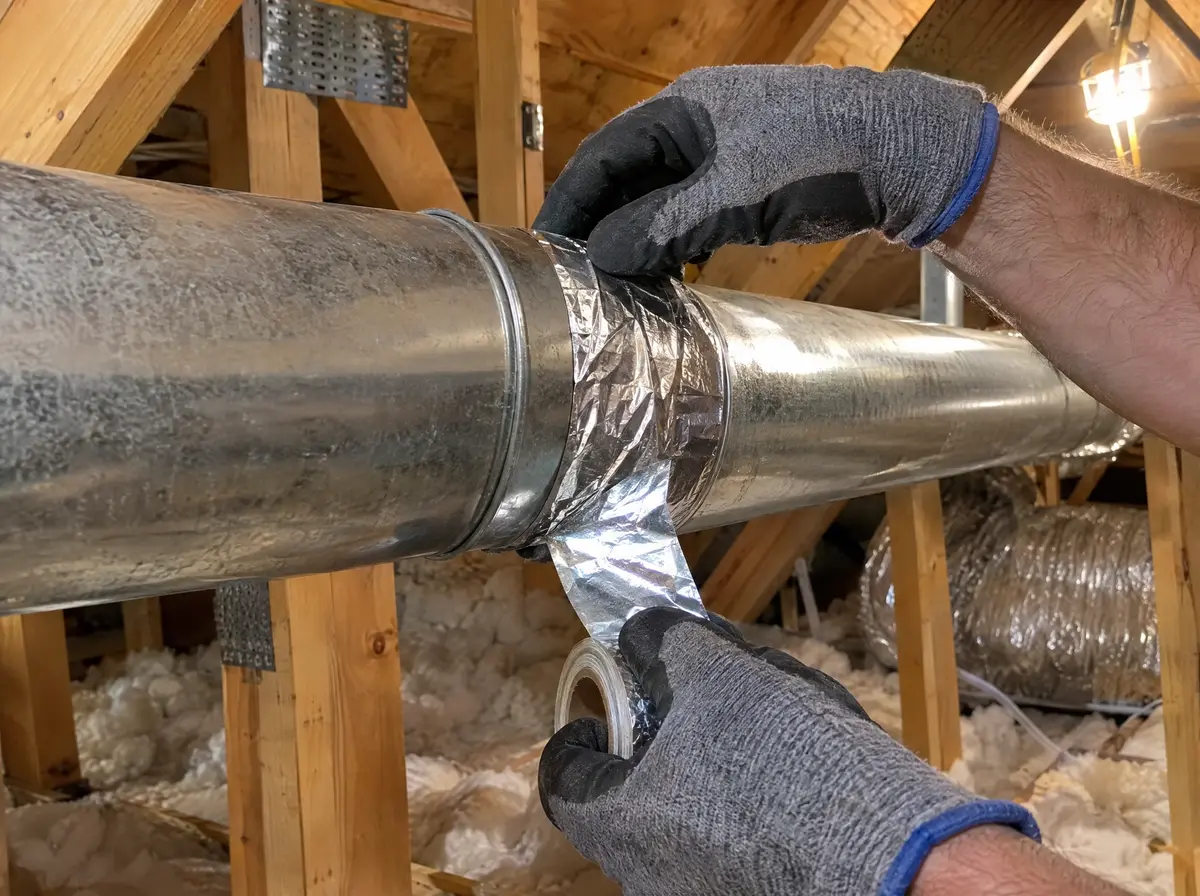
In each case the duct itself must still be right: 4 inch rigid metal with a smooth interior, joints sealed with foil tape and no screws, a listed transition hose under 8 feet, and a termination with a damper and no screen. The booster helps a sound system go further. It is not a patch.
When rerouting is better
Most of the long runs we see do not need a fan. They need a better route. Here is how the two compare:
| Situation | Better answer |
|---|---|
| Laundry sits near an exterior wall but the vent goes through the roof | Reroute to the wall |
| Run snakes across the attic with extra elbows | Straighten the route, cut the bends |
| Foil hose used for part of the run | Replace with rigid metal, which may bring it under the limit |
| Duct crushed or disconnected somewhere along the run | Repair the duct, then measure again |
| Run is long because of heavy lint, not distance | Clean the run first |
A booster fan in any of those cases adds a motor to clean and maintain, and leaves the real problem in place. A crushed section with a fan behind it is still a crushed section. Our article on roof versus wall dryer vents covers one of the most common reroutes.
What a booster fan asks of you
If you do have one, it needs attention:
- Cleaning. The fan sits in the lint stream. Its blades and housing collect lint and need cleaning with the rest of the duct.
- Access. It must be installed where it can be reached for cleaning and service, not sealed behind drywall.
- Power. It needs its own electrical connection, and if it stops, the dryer is suddenly pushing through a run that is too long.
- A working signal. Many dryer boosters include an indicator or alarm that warns when airflow drops or the fan is not running. It is worth having and worth paying attention to.
A failed booster on a long run is worse than no booster on a short one. That is the main reason we prefer rerouting wherever it is possible.
How we decide
We start by measuring. Airflow is read at the outside termination before anything else, then we trace the run and count the bends. We check the dryer manufacturer’s instructions for its allowed length and whether it permits a booster. Then we look for a shorter route through the wall, the attic or the roof.
If a shorter route exists, we recommend rerouting. That is a dryer vent installation at $200 to $600, using rigid metal duct on the shortest safe path with joints sealed in foil tape. If no shorter route exists and the dryer maker allows a booster, we recommend one, and the fan is quoted after we measure the run. Either way, we measure airflow again at the end so you can see the result.
Before you buy a fan yourself
If you are thinking of fitting a booster fan to fix slow drying, check three things first. Is the lint screen clean and the load a sensible size? Is the transition hose behind the dryer straight and connected? Does the outside flap open when the dryer runs? Slow drying has many causes, and a fan only addresses one of them.
If those check out and the run is genuinely long, contact us and we will measure it and tell you which answer fits.