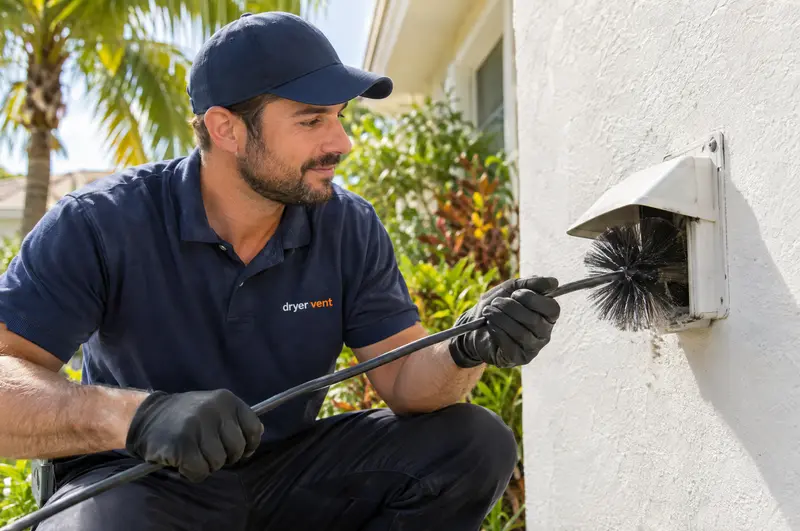

A ventless dryer is a good fit for a Florida condo when the unit has no practical route to the outside: the laundry closet sits in the middle of the floor plan, there is no exterior wall within reach, or the association will not allow a new opening in the building. If your unit already has a dryer vent and the problem is slow drying, the vent is usually the thing to fix. A dryer vent cleaning costs $100 to $200, far less than a new appliance.
How a ventless dryer works
A vented dryer heats room air, passes it through the clothes and blows the hot, wet air outside through a duct. A ventless dryer keeps the air inside the machine. It pulls the moisture out of that air, turns it into water and either collects the water in a tank or pumps it to a drain. The same air is then heated again and sent back through the drum.
There are two main ways to do that, and they behave differently in a small Florida condo.
Heat pump vs condenser
| Feature | Heat pump ventless dryer | Condenser ventless dryer |
|---|---|---|
| How it removes moisture | A refrigerant loop cools the air to condense water, then reheats it | Room air cools a heat exchanger that condenses the water |
| Heat released into the room | Low | Noticeable |
| Energy use | Lowest of the dryer types | Higher than heat pump |
| Cycle time | Longest | Long, usually shorter than heat pump |
| Purchase price | Higher | Lower |
| Water handling | Tank or drain hose | Tank or drain hose |
| Regular cleaning | Lint filter every load, plus a second filter or coil area | Lint filter every load, plus the condenser unit |
Exact cycle times and energy figures vary a great deal between models and load sizes, so read the manufacturer’s numbers for the specific machine rather than general claims. What holds across the category is the direction: heat pump models trade time for efficiency, condenser models trade some heat in the room for speed and price.
Many compact and stackable ventless dryers are 24 inches wide, which is why they show up in condo hall closets. A ventless stackable dryer on top of a compact washer is a common setup in older Florida buildings where the original plan had no laundry at all.
When a ventless dryer makes sense in a Florida condo
These are the situations where we tell owners that a ventless dryer is a reasonable choice:
- No exterior wall. Interior laundry closets in high rise buildings can sit across the whole unit from the nearest outside wall, with concrete slabs, beams and other units in the way.
- The association bans new penetrations. Exterior walls and roofs are usually common elements. Many Florida associations do not allow an owner to core a new hole through the building envelope, especially in concrete block or poured concrete towers.
- No legal route fits the code. The Florida Building Code limits a dryer exhaust duct to 35 feet of developed length, minus 5 feet for each 90 degree bend, unless the dryer manual allows more. Some interior closets cannot reach the outside within that allowance.
- Adding laundry where none existed. In buildings with a shared laundry room, a ventless unit may be the only way to put a dryer inside the apartment.
The trade offs in a Florida closet
Ventless dryers are not maintenance free, and Florida conditions make a few of the trade offs more noticeable.
Heat and humidity in the closet. Neither type is perfectly sealed. Some warm, damp air escapes into the room, and a condenser model deliberately dumps heat from its heat exchanger. In a closed laundry closet with solid doors, that heat and humidity build up. Follow the manufacturer’s clearances and ventilation requirements, keep louvered doors if the closet has them, and expect your air conditioning to carry part of the load. In a humid Florida condo where the AC already works hard in summer, that matters.
Longer cycles. A load takes longer than in a typical vented dryer, and overloading makes it worse. Households that do several loads a day sometimes find the pace frustrating.
Lint still has to go somewhere. The lint filter has to be cleaned every load. Most models also have a second filter, a condenser unit or a coil area that collects fine lint and needs rinsing or wiping on the schedule in the manual. When that step is skipped, drying times stretch and some models show a warning. In humid weather, lint left on a damp coil can turn to paste.
Water. A tank must be emptied after every load or two. A drain hose avoids that, but it needs a nearby drain, which may need association approval and a plumber.
When fixing the existing vent is the better answer
Plenty of owners start shopping for a ventless dryer because their current dryer takes two or three cycles. In most of those units, the dryer is fine and the vent is blocked. Before replacing the appliance, check the vent.
| What you see | Likely cause | Better first step |
|---|---|---|
| Dryer takes two cycles, top of dryer hot | Lint in the vent run or the termination | Vent cleaning, $100 to $200 |
| Foil hose crushed behind a stackable | Transition hose flattened | Replace the hose, straighten the connection |
| Vent runs into a shared building riser | Riser loaded with lint from several units | Ask the association about a building cleaning |
| Duct disconnected inside a soffit or ceiling | Broken connection | Vent repair, $200 to $600 |
| No vent exists and no route is allowed | Building layout and rules | Ventless dryer |
Our guide to a dryer that takes two cycles to dry walks through the checks in order. If the vent is shared with other units, our article on condo dryer vent responsibility explains who usually handles which part.
Never vent a regular dryer indoors
A vented dryer must exhaust to the outside. Indoor lint traps, small boxes with a filter and buckets of water sold as a fix for units without a vent let fine lint, moisture and heat into the home. In a Florida condo, that moisture feeds mold in closets and drywall. For a gas dryer, venting indoors is dangerous because combustion products come with the exhaust. If there is no vent, the answer is a dryer built to run without one.
What to ask before you buy
Before ordering a ventless dryer, confirm a few things with the association and the product specifications:
- Does the association have rules on dryers, water connections or work inside units?
- What electrical circuit does the model need? Some compact models run on a standard outlet, others need a dedicated 240 volt circuit.
- Is there a drain within reach, or will you empty a tank?
- Does the closet meet the clearances and ventilation in the installation manual?
If your unit does have a vent and you are not sure whether it can be saved, a dryer vent inspection measures airflow at the outside and traces the run, so you know before you spend money on a new appliance. For buildings, our condo and apartment dryer vent service is priced per unit and quoted per building. You can reach us through the contact page.